
The White Mountains’ Diviner
Walled in Books

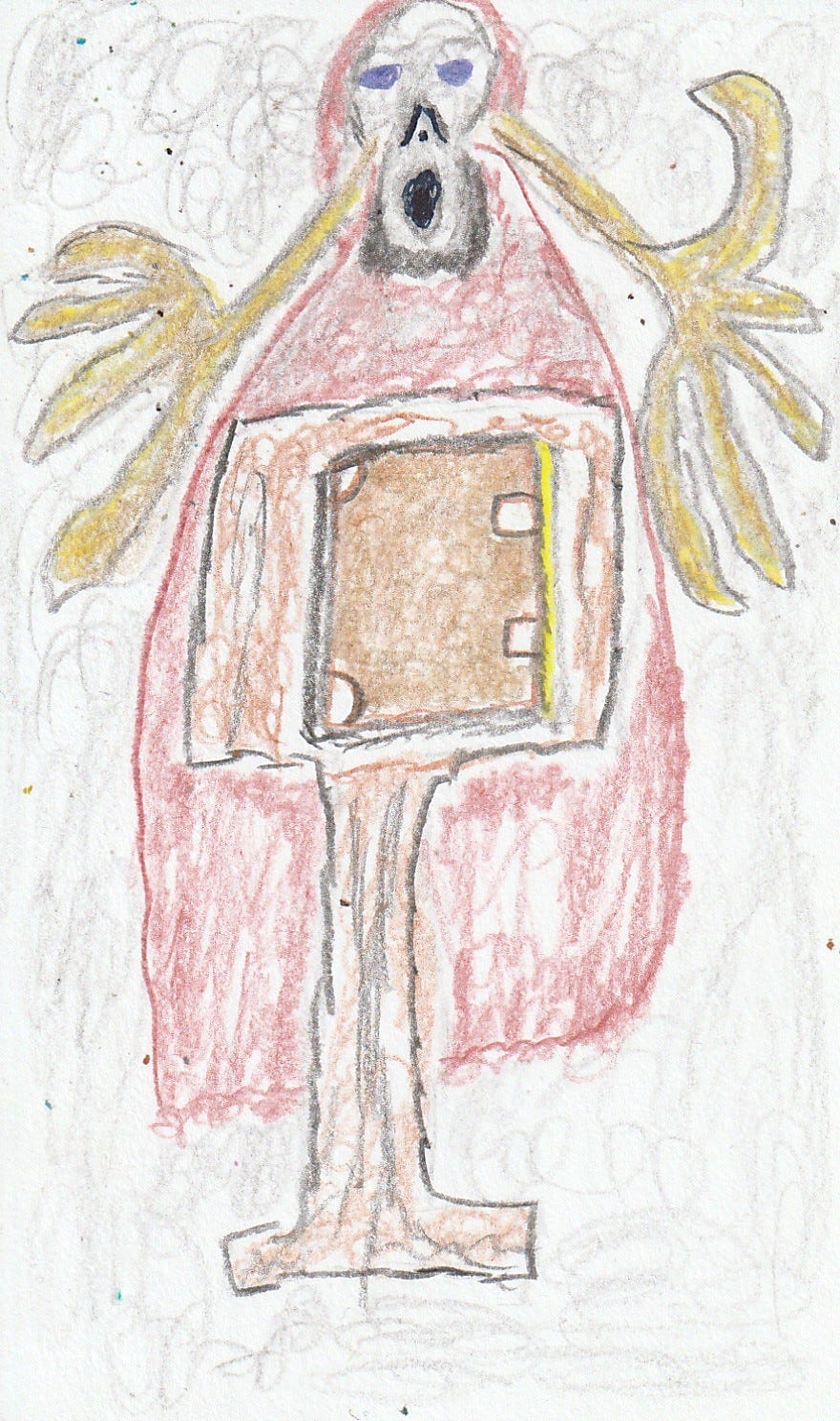
This piece was written for the “Welcome to the Hinterland” collection:

Falgiri shot to rigid attention nearly mid-step. He was descending from the White Mountains when, below him, in the valley basin, he saw the conoid spire that had invaded nearly all his dreaming divinations. The whorls of gold surrounding the dusky pink spike were unmistakable. He loosened the maroon face covering attached to his head wrap, pulling it down underneath his lantern chin and thick black beard. He used this opportunity of expectant awe and elevated vantage to take a long pull of water from his canteen. Thirst momentarily quenched, he peered through his golden spyglass, double confirming his destination. He, with cautious haste, replaced the facial covering. The radon in the air was nearly visible, as particles and specs glinted in the receding sun. Falgiri knew that he was immune to this aspirated toxicity, but he remained vigilant about his respiratory apparatus. He was destined to complete his task and did not wish to tempt any gods. He had been chosen and given certain gifts, but as informally as he was selected, he could be casually wasted away. Such is the blind will of his gods.
Stepping from the edge of the snow-capped mountains onto the coarse granite sand was a relief from a temperature perspective, but what Falgiri’s humble footwraps lacked in warmth, they also lacked in basic protection. His slender feet and long toes were chapped and split from the formerly frigid air, and the sand he now trekked through was grinding and shredding the exposed bits of flesh on his feet. This severe discomfort slowed the pace of his sojourn, but the stinging nerve sensation Falgiri felt was beneficial. As he limped closer to his spiral destination, the coarseness of the sand began to recede, gradually being replaced by a talc-like softness. Had Falgiri not been so keenly aware of his feet, this sensation might have been overlooked.
Placing his long orbstaff firmly on the last bit of solid crust, Falgiri evoked a spell which illuminated the air around him. The setting sun was playing its illusory tricks and had he not added this extra source of light, the true nature of the landscape he was entering would have sprung itself on him as an unfortunate plummet. With unnatural division, the former razor-sharp golden granite sand immediately gave way to gray, light powdery dust. This dust chasm was seemingly several meters thick and matched, with perfect deception, the level of the sand. Falgiri correctly theorized that due to this dust’s total lack of density, it would not have supported his weight.
He stood for a moment on this precipice. The desiccated expanse ahead spat delicate cyclones as distance markers. The particles comprising the next part of his journey were so without mass that the light beaming from his orbstaff drew them in, like a gravitational pull.
He examined his robe under this eldritch staff’s light, and the once vibrant maroon coloring was bedimmed with this ultrafine environmental residue. He could feel floury sediment in his nostrils, and the smell that accompanied this olfactory invader left a tomb-sweet, ancient chalky coating in his mouth. Falgiri attempted to clear his nose; after failing, he adjusted his face covering. This time, he was sure to pull the covering tight, cinching it just underneath his eyes. Despite an irresistible coughing fit and the discomforting circumstances, this predicament again helped to confirm the truth of his divinations. He was on his mandated path.
The book he sought, “The Testaments of Carnamgos” was nearby. Nothing else could explain this abundance of pure deterioration. The ultimate corruption its pages foretold had to be uniquely responsible.
Falgiri removed the heavy woolen glove from the end of his left arm. Underneath this glove was the gnarled, sinewy, bramble-like remnants of a hand. The shapes that now represented fingers were twisted into complex knots. Each former digit was so infinitely disfigured that it would be impossible to identify any of the original five roots. The color of this remaining protuberance was akin to dark mahogany, but despite its arid mummified aspect, its appearance remained oddly hallowed. This contradiction of decay and glory only hinted at the umbra of its actual power. A faint Lapis shade flooded into Falgiri’s eyes. As this color rose, it pushed aside the usual amber hue of his irises.
Falgiri stretched his withered hand over the sea of dust; a strong east wind began to blow, and the sere ocean of particles began to shift. A firm gale cleaved the lifeless remains surrounding him and formed a wall to his right and to his left.
1,416 steps to the entrance.
The Mall holds the book.
Falgiri began counting his steps with his eyes locked on the spire that loomed ahead. When he reached 708 steps, he could feel a firmness return to the ground, and as the cleansing gust continued, beneath his feet became a blacktop parking lot. The setting sun’s rays pierced the darkness that fluttered in the sky and continued their journey until abruptly changing course after reflecting off the glass entrance to the White Mountains Mall. These sliding doors sat directly beneath that conical golden beacon that marked this location.
The hands on this spire’s newly revealed clockface hung exhausted with ataxia, both pointing at the vertical slash meant to represent six. Time had long since lost its meaning, and this mechanical reminder rattled Falgiri’s usually stalwart spine with nostalgic dread. When in reach of the brass-door-handled entrance, Falgiri relaxed the concentration needed for his wind evocation. The mile-long path his easterly gusts created collapsed suddenly with a hushed thud; not a single foot of space behind him escaped its reburial.
The mall’s immediate exterior itself was left untouched by the atmosphere of entropy that had overtaken the land. The signage meant to welcome throngs of consumers was still pristine. Falgiri paused and leaned close to inspect this archaic image. At first glance, it appeared too abstract to represent middling mall culture. To Falgiri, it looked like a fetus in utero, but as his eyes adjusted, he could see that it was a horse and rider artfully scrawled in pastel segments. He wondered what facet of this former cultural center this sign was supposed to represent. The image spasmed in his brain like a forgotten trauma. It retriggered an early divination of horses racing around a track. These half-remembered sensations furthered the certainty that he has been summoned to this exact spot his entire life.
Standing at this doorsill, all he needed to do was enter. He reached and pulled with his right hand. After some resistance, the conveniently ergonomic handle began to yield. The seal on the mall doors popped like a champagne bottle. The sound echoed through the forgotten and disused building.
The interior of the mall was fully lit. Whatever energy source was powering these lights emitted a quiet yet jarring wave. This near-inaudible sound quaked Falgiri’s spine for a second time this day. This instance of weakness was more somatic than the previous one; had this noisome nostalgia not been accompanied by an antiseptic bouquet, Falgiri might have collapsed under its invisible weight.
Falgiri steeled himself to the new yet familiar smells and sounds.
He allowed his eyes to take in the visual absurdities he now beheld. Ludicrously high ceilings, aquamarine steel scaffolding, reflective metal railings, potted plants, textured square pillars, and high gloss floors made of polished synthetic stone.
In addition to all these vapidly decorative signifiers, there were seemingly endless walls of glass—every available free space was filled with enormous clear panes. Falgiri could gaze from one end of the first floor through to the other. The entire field was divided and segmented with purposeless transparency.
A creeping dread of divination retched into Falgiri’s mind:
Walls
Walls of glass
Walled in
Walled in books
Waldenbooks
When he regained a sense of his locus, the index finger on his right hand rested on the mall directory. It pointed right to the name Waldenbooks. This was the location of The Testaments of Carnamgos.
A soft vibration radiated through chapped and bleeding feet. The grooved metal of the escalator carried Falgiri upwards towards the second floor. The tattered ends of his robe clutched high to avoid being caught in the endlessly ascending steel jaws. Falgiri jumped over the threshing threshold, and he made his way toward his destiny.
The Waldenbooks sign glowed white. As he approached, he could see advertising posters bespeckling the entrance. Each poster was written in fluorescent pink and featured the word Carnamgos in thick block letters.
Falgiri entered the store calmly. There were dozens of empty shelves and vacant display cases.
Not a single other book remained.
In the middle of this vacuum on a plastic lectern was a shagreen book. Above the solitary book, a yellow arrow pointed downward, with a sign that read “Employees’ Picks.” Falgiri leaned in to inspect. The book on the stand was a plain volume. No writing, symbols, or engravings gave any clue to what was contained inside. Bone white clasps on its spine reeked of a sweet decay. The scent was so overpowering that it created a mirage of visible decrepitude. Falgiri’s eyes again glowed light lapis, and he began to convulse. He entered a trance-like state as a divination overtook his personage:
Twisted golems roamed the shiny floors; hundreds of them.
Each was comprised entirely of mealy droplets, decayed hovering pinpricks.
These dwellers had no eyes, but they endlessly scanned for more.
They had no ears, but they strained towards offers of material salvation.
They had no mouths, but they screeched for sustenance to quell their limitless hunger.
Each singular entity shambled; they dragged miniature versions of their corporeal nothingness behind them. They looped and ambled in small circles—a ritual farce, fawning in a futile effort to gather up bits of themselves mindlessly discarded. Stubby fingerless hands clawing at specs of their individualization.
Some of them collapsed under their own weight. Some of the less cautious ones crashed violently into their shadowselves, forming massive conglomerations.
Once formed, these rare joint entities would surge upward like an eruption, only to split and sunder back to dusty piles of weightless null.
Each catastrophic collapse kicks up more waves of dust. Clusters of obscurity began to stick to Falgiri’s damp retina.
At first, these spots came dense, slow, and deliberate. They came with an intentional metronomic patter.
Much later, they all came at once.
A thick sudden-onset cataract.
The last irritated slice of vision before total obscuration was a decrepit left hand touching the seam of The Testaments of Carnamgos.
Falgiri’s knotted hand caressed the calcium phosphate clasps of that accursed book. Total atomization began. First flecks, then parched chunks. The process started at that latent imperfect appendage and splintered quickly, traveling up the veins and across the nerves, shattering anything that still retained moisture. His eyes filled with purplish sand as he watched his body blink away into disintegrated blankness.
Each corpse-atom that once comprised Falgiri was free to seek its own place to rest. Some chose the cool mock stone floor, and others aspired toward the comfort of the electric lights overhead and their sentimental hum.
The Testaments of Carnamgos rested comfortably on its lectern, patiently waiting out a wanton forever.
Patiently waiting for its next beguiled oracle.
The Testaments of Carnamgos and other aspects of this story were taken directly from Clark Ashton Smith’s “The Treader of the Dust.”

This reminds me so much of Frank Herbert. Gotta have a special something to write like this. It’s beautiful.
Nathan your craft is excellent here. I love the dense, atmospheric storytelling, and how you make a familiar setting, a mall, into a strange, post-apocalyptic wasteland.
The 'far-future technology resembling magic' theme gives me serious Gene Wolfe vibes, of whom I am also a huge fan, and I consider him to be a strong influence on my science-fiction work as well. Am I pegging you correctly?